Skip to content

Platform

Everything the system does — in one place.

A due-diligence reference for the people who evaluate before they recommend. Every item here ships today; roadmap is labeled as roadmap.

Core capabilities

The whole toolkit, not a teaser.

Patients & MPI

Registration with duplicate detection, MRN number series, document uploads, and merges that carry active allergies forward.

Scheduling & queues

Appointment board with slot holds, walk-in queue tickets, and emergency-first calling at the counter.

EMR & encounters

A single-screen consult: notes, vitals with automatic interpretation, ICD-10 diagnoses, and e-prescriptions.

Orders & laboratory

Stat → urgent → routine worklists, result entry and verification, and critical-value escalation with deadlines.

Radiology

Priority worklist, scheduling, PACS study metadata, versioned signed reports, and critical-finding escalation.

Pharmacy & inventory

Prescription validation, FEFO dispensing with live on-hand, controlled-drug witnesses, and a lot-level stock ledger.

Inpatient, ED & ICU

Admissions and bed boards, an eMAR with stated dose times, acuity-first ED triage, and ICU flowsheets with corrections.

Billing & claims

Charge capture behind every invoice, discount approvals, cashier shifts, and payer claims adjudicated line by line.

Specialty suites

Operating theatre with checklist gates, maternity, dental odontogram, optometry, vaccination, telemedicine, messaging, and more.

For the front desk

Front desk without the queue chaos.

Booking, arrivals, queues, and the cashier drawer — the flows that set the tone for the whole visit, made fast and hard to get wrong.
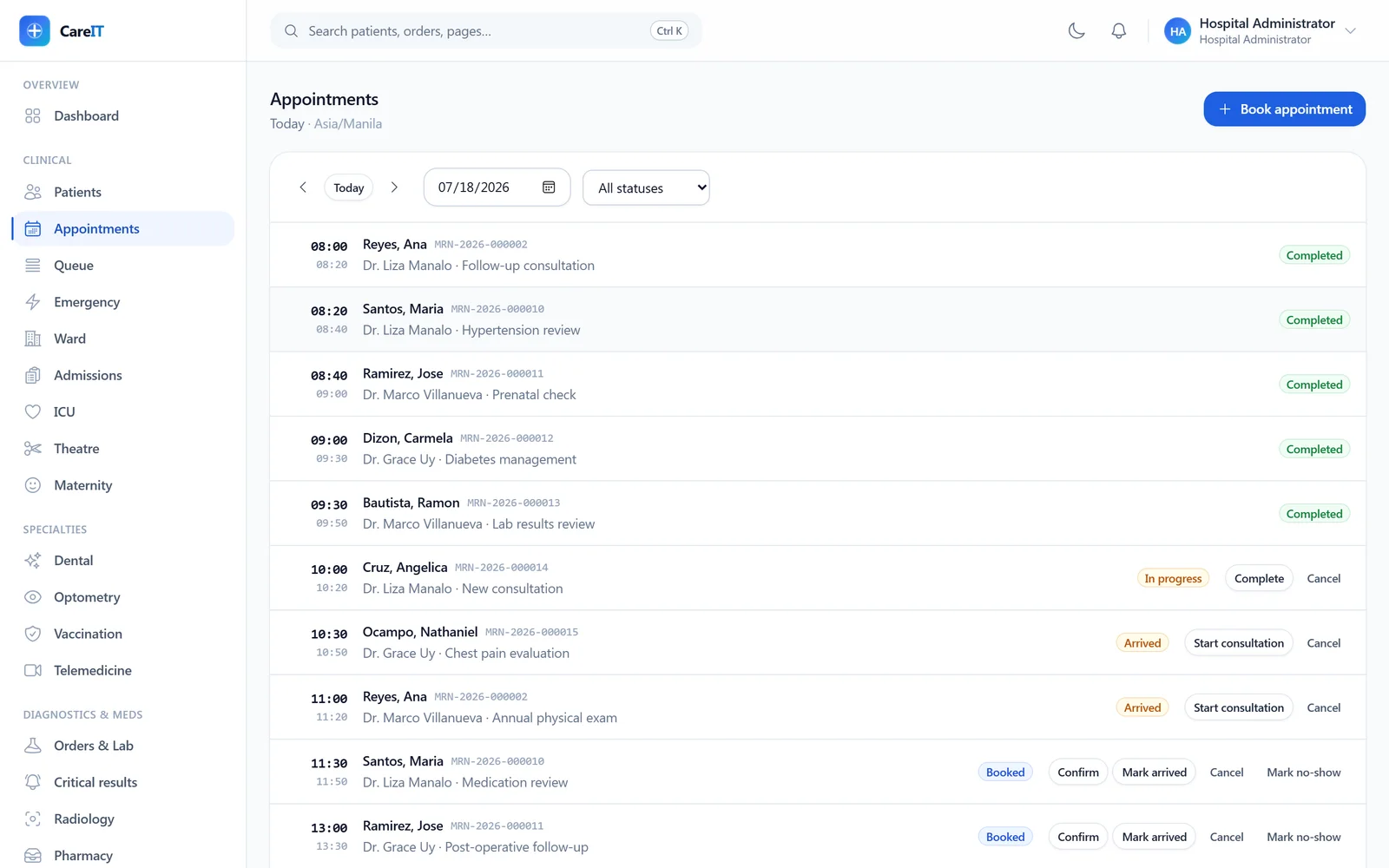
  • Patient search and registration with duplicate detection built in
  • Appointment booking with practitioner schedules and slot holds
  • Walk-in queue tickets with emergency-first calling
  • A cashier desk with shift open/close and cash-only drawer reconciliation
  • Patient documents uploaded straight to the chart
CareIT HMS appointment board showing a day of booked appointments with statuses and booking controls
Appointment board — actual product UI

For clinicians

A chart built for the 90-second reality.

Notes, vitals, diagnoses, orders, and prescriptions on one screen — with the identity banner pinned above everything, every time.
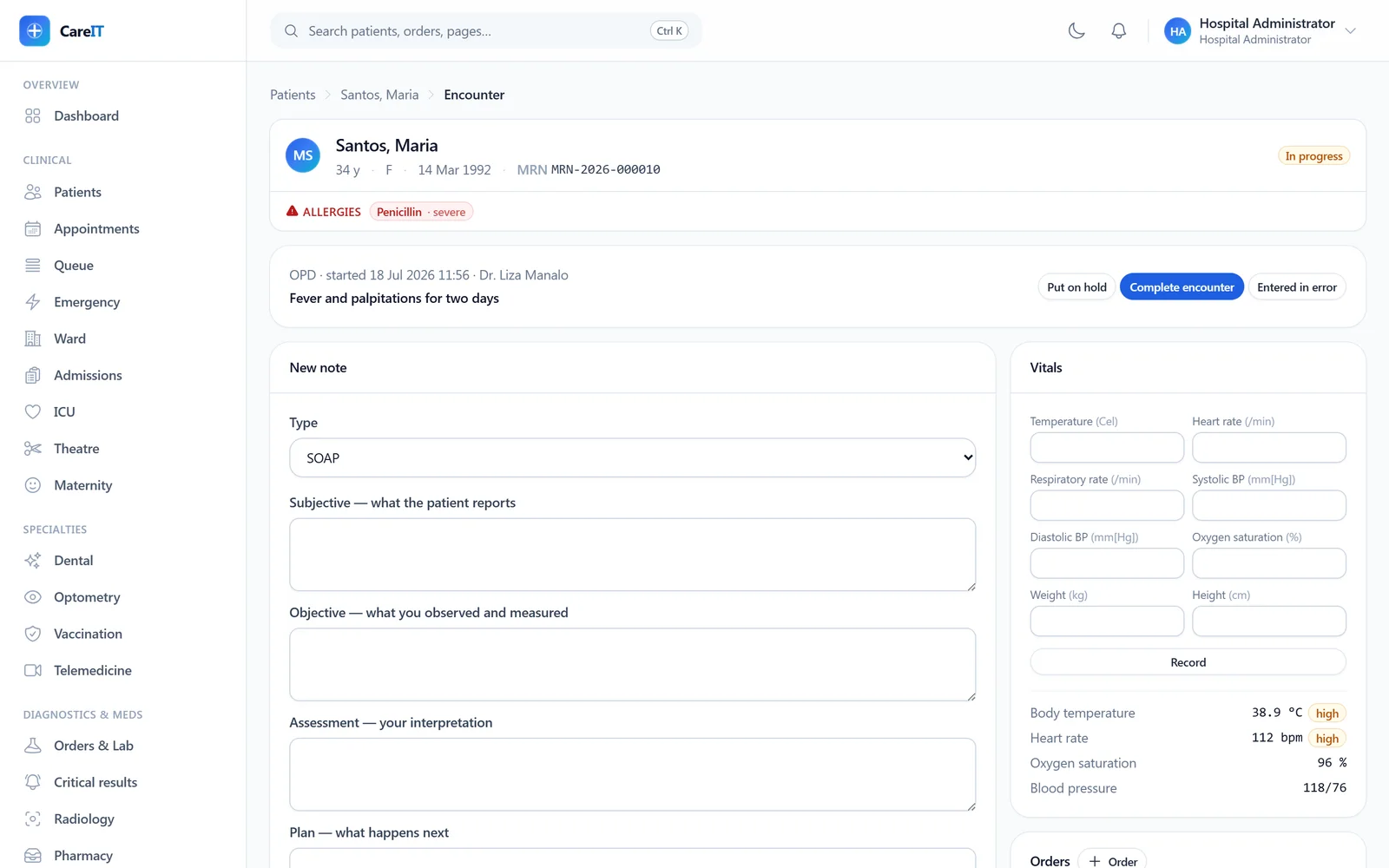
  • The full consult on a single screen — no navigation between note and orders
  • Vitals interpreted automatically against reference ranges as they are recorded
  • ICD-10 diagnosis typeahead, orders and e-prescriptions without leaving the chart
  • Amendments supersede prior versions — the record is append-only by design
  • Closed encounters become read-only; every write affordance disappears
CareIT HMS encounter chart with patient identity banner, clinical note composer, vitals, and diagnoses on one screen
Encounter chart — actual product UI

For administrators

The whole facility on one screen.

Twenty-nine modules behind one grouped navigation — clinical boards, workforce, finance, analytics, and the system itself.
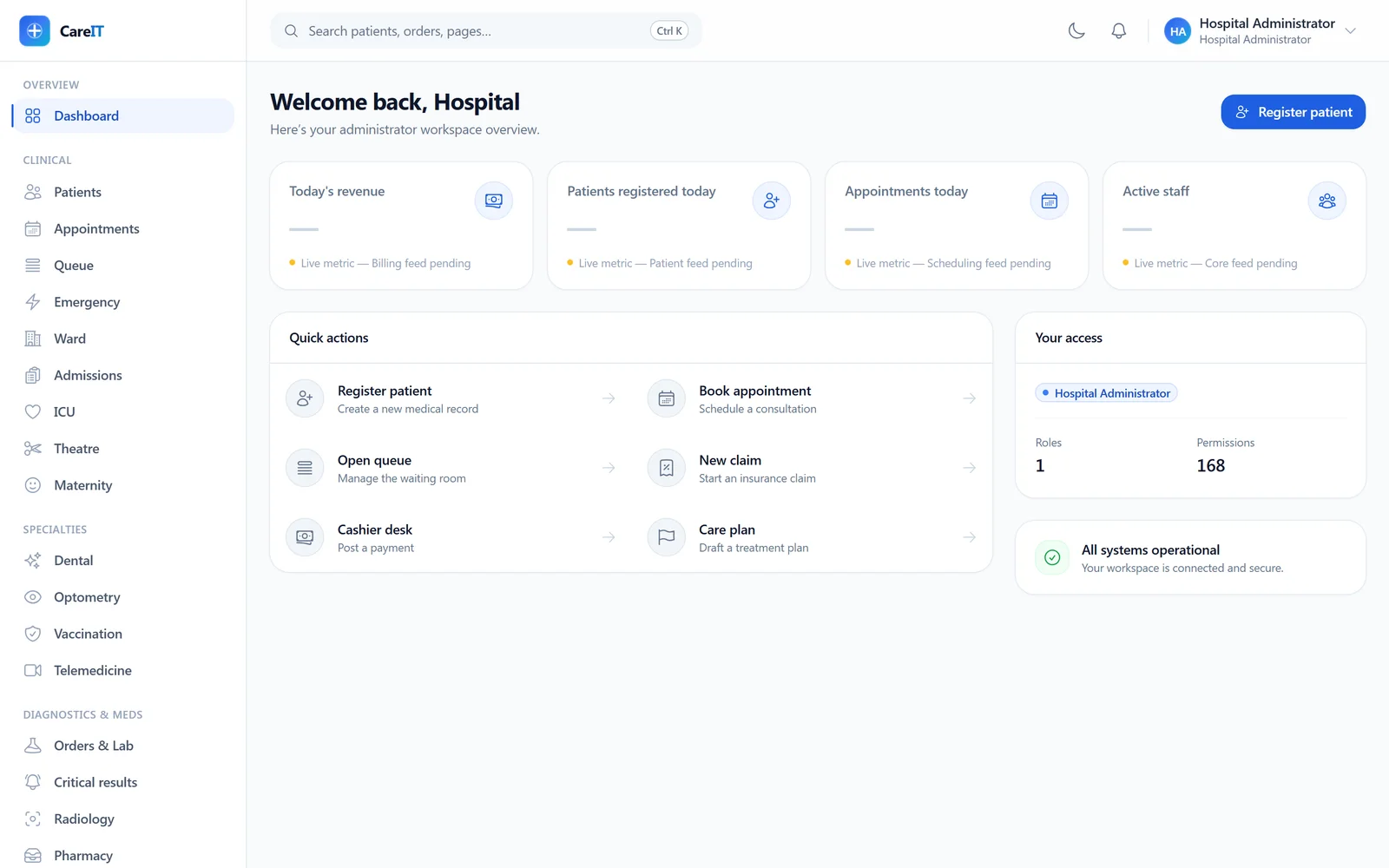
  • Role-aware navigation: staff see exactly the modules their permissions allow
  • Workforce rosters with minimum-staffing gates and credential expiry tracking
  • Analytics with cohort exports and k-anonymity floors on small groups
  • System health checks, maintenance windows, and backups with verified restore tests
  • Module toggles double as licensing — enable what your facility licenses
CareIT HMS administrator dashboard with quick actions, access summary, and grouped module navigation
Administrator dashboard — actual product UI

In depth

The details evaluators ask about.

Clinical safety

The safety details we obsess over.

The dangerous failures in hospital software are quiet ones. CareIT HMS is engineered against them, case by case.

  • A 38.9 °C temperature is flagged high the moment it is recorded — interpretation derives from reference ranges automatically
  • Critical flags come only from explicit rules or the verifying pathologist — never from arithmetic that pages people for noise
  • The ED board pins unassessed arrivals first, then sorts by acuity, then by longest wait — never by arrival time
  • A merge moves active allergies to the surviving chart — the prescriber sees them, and the auditor keeps the history

Revenue integrity

Charges are facts. Invoices are presentations.

Billing is downstream of care, never invented at the desk. The ledger of captured charges is the single source every invoice and claim is built from.

  • Labs, drugs, procedures, and implants capture charges at the point of care
  • Discounts require an approver who isn’t the requester — separation of duties, enforced
  • Cashier drawers reconcile counted cash against cash takings only; card and other methods are reported, not folded in
  • A charge already on one claim can never be billed to a payer twice

Access & audit

Every action has an owner.

Access is scoped to the action, not the job title — and everything privileged leaves a record that cannot be quietly edited.

  • Permissions per action (module.resource.action) with role presets per facility
  • Break-glass access for emergencies — always available, always audited
  • A hash-chained audit log covering privileged actions and PHI reads, portal logins included
  • Two-person rules where they matter: discount approval, leave approval, patient-merge sign-off

Clinical time

Facility time, not server time.

Hospitals run on ward clocks, not UTC. Every human-facing time in CareIT HMS goes through the facility clock, and every stored instant is normalized.

  • Boards show the facility’s “today” — a Manila receptionist never sees yesterday’s schedule at 2 a.m.
  • Dose times on the eMAR are stated by the ward as prescribed — “TID” is shown verbatim, never guessed into 06:00/14:00/22:00
  • Scheduled instants are normalized to UTC at the boundary, so an 09:30 slot never drifts eight hours

API-first

Everything the UI does, the API does.

The web app is a client of the same documented REST API you get — nothing hidden, nothing “enterprise tier only.”

  • 240+ endpoints documented in an OpenAPI 3 spec that is validated against the live route table
  • Public ULIDs in, human names out — internal integer keys never leak
  • Server-owned state machines: every record advertises exactly the transitions it allows
  • Idempotency keys on money and medication paths — a retried request never double-charges or double-doses

Shipped vs roadmap

What’s real today — and what’s next.

We keep this split honest on purpose: everything in the left column is built, tested, and demonstrable on a live instance. The right column is planned, not promised on a date.

Shipped today
  • All 29 modules — outpatient core, full hospital, and specialty suites
  • Append-only EMR with amendments and versioned reports
  • Critical-value and critical-finding escalation with deadlines
  • Charge capture, invoicing, cashier shifts, claims adjudication
  • Patient portal API with release rules, proxy access, and consents
  • Offline mobile sync for vitals with an honest conflict queue
Roadmap
  • Payer e-claims adapters (including PhilHealth)
  • Push notifications to devices (FCM/APNs)
  • Video-provider integrations for telemedicine sessions
  • GL-specific accounting export adapters
  • A packaged patient-facing mobile app (the API is ready today)

API-first

Built API-first, so it plays well with others.

Every screen in CareIT HMS runs on the same documented REST API you get — 240+ endpoints under an OpenAPI 3 spec that is validated against the live route table. If the UI can do it, your integration can too.

  • REST API with OpenAPI 3 spec
  • Offline mobile sync — vitals captured off-line land safely, conflicts surface honestly
  • Patient portal API, ready for your patient-facing app
  • Accounting export batches for your general ledger
  • PACS study metadata on radiology studies
  • Your SMTP for email

Roadmap: payer e-claims adapters (including PhilHealth), push notifications (FCM/APNs), video-provider integrations for telemedicine, and GL-specific accounting adapters.

Open the product guide

See the whole system on a live instance.

A working walkthrough beats any feature list — we’ll drive it with your facility in mind.